

Your backtest isn't a win/loss calculator. It's a high-stakes simulation designed to break your logic before the market does it for you. Most traders treat historical data like a crystal ball, yet they still find themselves blindsided by real-world slippage or 0.05% exchange fees that turn "profitable" bots into money pits. You know the feeling of a strategy that looks perfect on paper but fails the moment it hits a live exchange. It's the curse of curve-fitting, and in the 2026 market, it's a mistake you can't afford.
Mastering crypto trading bot backtesting is about more than just running a script. It's about building a disciplined command center that respects risk-to-reward ratios and understands modern volatility. This guide provides the framework to transform raw market data into a validated, live-ready strategy. We'll explore how to use AI-graded market setups to filter your logic and ensure your bot survives the latest regulatory shifts. By the end, you'll have the technical clarity to deploy your automated systems with absolute confidence in their performance.
Key Takeaways
- Navigate 2026 market volatility by replacing "gut feelings" with high-fidelity simulations that stress-test your logic against historical regimes.
- Identify the "hidden leaks" in crypto trading bot backtesting, such as taker fees and slippage, that can turn a winning strategy into a money pit.
- Avoid the overfitting trap by prioritizing simplicity over complexity, ensuring your bot remains agile rather than fragile when market conditions shift.
- Implement a rigorous three-step validation workflow that bridges the gap between historical simulation and live execution.
- Leverage AI-driven market intelligence to filter for high-probability setups, focusing your backtesting efforts only on strategies with a proven mathematical edge.
The Science of Sanity: Why Crypto Trading Bot Backtesting is Non-Negotiable
Trading without data is just gambling with better UI. In the current market, crypto trading bot backtesting is the only thing standing between a disciplined portfolio and a catastrophic margin call. At its core, backtesting is a high-fidelity simulation. You are running your bot's specific logic against historical Open-High-Low-Close (OHLC) data to see how it would have actually performed. It's a way to prove that your genius idea works before you feed it real capital.
The 2026 landscape has changed the stakes. With the MiCA regulatory framework now fully active as of July 1, 2026, and the SEC shifting toward more defined rulemaking, the "wild west" era of gut-feeling trading is officially a liability. Markets are more efficient, and volatility is more calculated. You need to transition from a gambler to a strategist. The goal is Strategy Robustness. This is the measure of how well your logic holds up across different market regimes without breaking the moment a trend reverses. If your bot only works in a moon-mission scenario, it isn't a strategy; it's a prayer.
The Cost of Skipping the Simulation
Skipping the simulation is a choice to learn through loss. Untested bots are notoriously fragile. They often fail spectacularly during "Black Swan" events or sudden shifts in market sentiment that they weren't programmed to recognize. Beyond the financial hit, there's a heavy psychological toll. Watching an unvalidated bot enter a deep drawdown without knowing if the logic is fundamentally broken creates a cycle of panic and manual interference. In the context of automated risk management, a drawdown is the percentage decline from a peak to a trough in your account balance, representing the maximum pain your capital must endure before hitting a new high.
Backtesting as a Competitive Edge
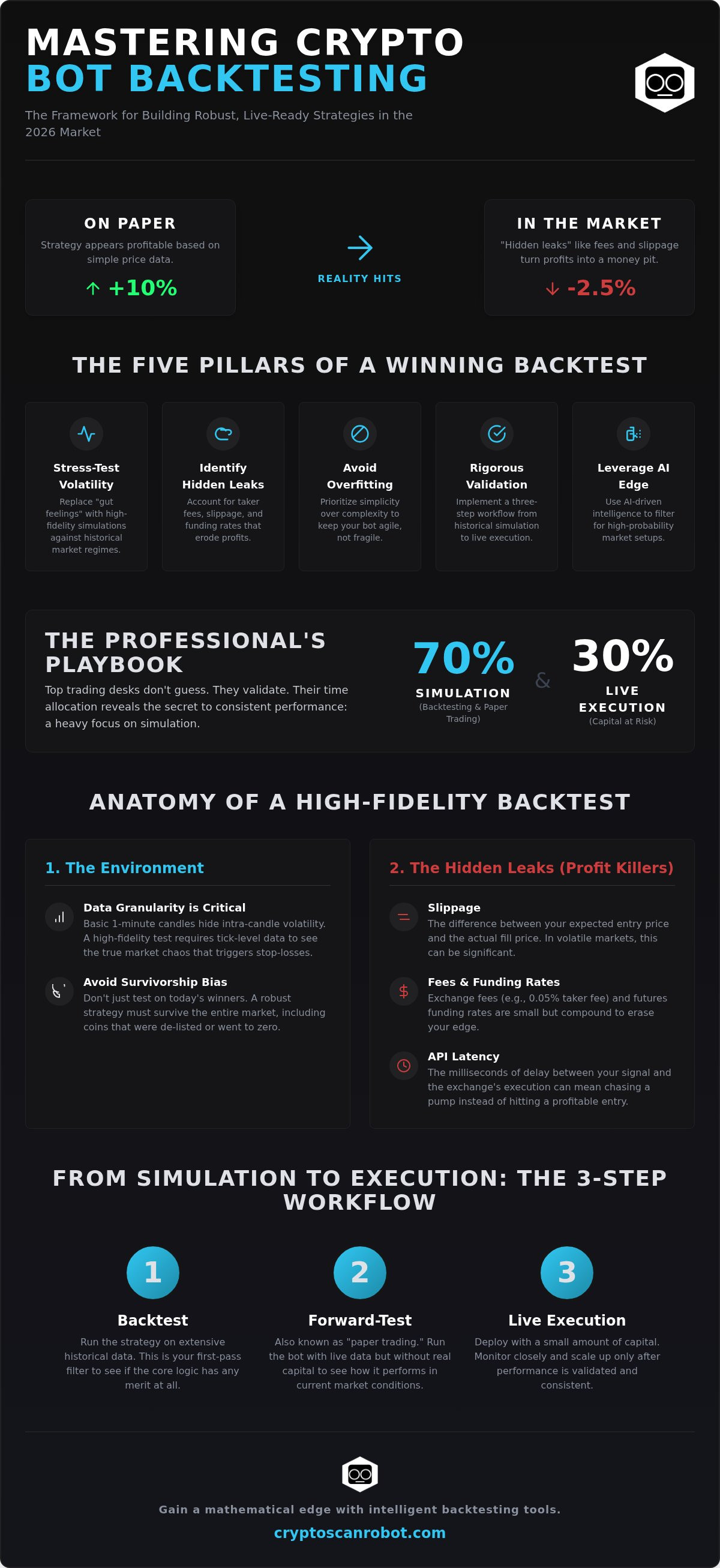
Professional trading desks don't guess. They spend approximately 70% of their time in simulation and only 30% in live execution. This lopsided ratio ensures that by the time a bot goes live, its edge is a mathematical certainty, not a hope. High-probability setup detection is the foundation of this process. Using the CryptoScanRobot portal, you can utilize the Market Setup Scanner to act as a filter. It identifies which setups even deserve the effort of crypto trading bot backtesting in the first place. When you combine this with AI Market Intel Reports, you gain the situational awareness that raw price data often misses. It transforms your trading setup into a centralized command center where logic always trumps emotion.
The Mechanics of a High-Fidelity Backtest: Beyond Simple Price Data
High-fidelity crypto trading bot backtesting requires more than a CSV file of closing prices. It demands a realistic environment. If you're running a high-frequency scalping bot, 1-minute candles are a blindfold. You need to see the intra-candle volatility and the actual spread. Without tick-level data, your bot is essentially guessing what happened between the open and close. This lack of granularity often hides the sharp reversals that trigger stop-losses in the real world.
Then there's the "Hidden Leak." Most basic backtests ignore the friction of the live market. A strategy that returns 10% on paper can easily end up in the red once you factor in exchange fees, like the 0.05% standard on Pionex, or funding rates in the futures market. If your simulation doesn't account for these costs, you're not backtesting; you're daydreaming. You also need to factor in API latency. Execution isn't instant. The milliseconds it takes for your command to reach the exchange can be the difference between a profitable entry and chasing a pump.
Data Quality: The 'Garbage In, Garbage Out' Rule
Clean data is the fuel for your command center. Using aggregated, noisy data from multiple sources can smudge the specific signals your bot relies on. You must also account for survivorship bias. If you only test your strategy on the top 50 coins currently on the leaderboard, you're ignoring the hundreds that went to zero or were de-listed. True stress testing requires looking at those low-volume periods where liquidity was thin and spreads were wide. This is how you ensure your bot doesn't just survive the winners, but survives the market as a whole.
Accounting for Execution Friction
Slippage is the silent profit killer. Your "perfect" entry in a backtest assumes you can fill any order size at the exact mid-price. In reality, you're hitting the order book and moving the price against yourself. A robust backtest includes a slippage buffer based on the pair's average liquidity. You should also simulate margin calls and liquidations if you're using leverage. Seeing how your bot handles a 20% flash crash on 5x leverage in a simulation is much cheaper than seeing it happen in your live wallet.
Your bot needs a personality for every market regime. A trend-follower that crushes a bull run will likely get chopped to pieces in a sideways "crab" market. Segment your data. Test your logic specifically against the high-volatility spikes of 2025 and the grind of 2026. To help define these entry conditions with mathematical precision, you can use the Market Setup Scanner to filter for regimes where your strategy actually has a proven edge. This ensures you only deploy when the odds are in your favor.
The Overfitting Trap: How to Build Strategies That Don't Break
Overfitting is the ultimate sin in crypto trading bot backtesting. It happens when you build a bot that acts like a historian rather than a trader. This process, also known as curve-fitting, involves tweaking your parameters until they perfectly match a specific slice of historical data. The result is a strategy that looks like a money-printing machine on paper but collapses the moment it faces live price action. You aren't teaching the bot to recognize a market edge; you're just forcing it to memorize the noise of the past.
The best defense against this trap is the Rule of Simplicity. A bot cluttered with 15 different indicators and complex "if-then" chains is almost always more fragile than one using three clean, logical signals. Every extra variable you add is another opportunity for your logic to mistake a random coincidence for a repeatable pattern. To validate your results, you must use Out-of-Sample Testing. This involves splitting your data into two distinct buckets. You optimize your bot on the first 70% of the data and save the final 30% for a "blind" test. If the performance doesn't hold up on the data the bot hasn't seen yet, your strategy is overfitted and ready for the scrap heap.
For a more dynamic approach, professional strategists use Walk-Forward Analysis. This method simulates the evolution of a strategy over time by using a rolling window of optimization and testing. It forces the bot to adapt to shifting market regimes, ensuring the logic remains robust as we move through the volatile cycles of 2026. It's the difference between a bot that was lucky once and one that has a durable mathematical advantage.
Red Flags of an Overfitted Strategy
Extremely high win rates, specifically those above 90%, are rarely a sign of genius. They usually signal a strategy that refuses to take a loss, leading to massive, infrequent drawdowns that can wipe out months of gains in a single move. You should also be wary of performance that relies on one or two "lucky" trades during a massive market pump. A smooth equity curve is more trustworthy than a jagged one because it signals consistent risk management rather than a reliance on volatile outliers. If your bot's success is concentrated in a tiny window of time, the logic is likely flawed.
The Monte Carlo Method
The Monte Carlo Method is your final stress test. It involves running thousands of simulations where you randomize variables or shuffle the sequence of historical price action. If your bot remains profitable even when the market's "luck" is rearranged, you've found a resilient edge. You can use the CryptoScanRobot portal to refine this process further. By cross-referencing your results with their AI-generated trade setup grades (A-F), you can quickly see if your backtested entries were high-probability setups or just statistical flukes. It provides the high-tech precision needed to ensure your bot is ready for the command center.
From Simulation to Execution: The 3-Step Validation Workflow
A successful backtest is a green light, not a finish line. The transition from historical data to real-time execution is the point where most traders fail because they confuse "logic" with "execution." You might have a strategy that technically works, but if it can't navigate the friction of a live order book, it's useless. To avoid this, you need a methodical three-step validation workflow that bridges the gap between theory and profit.
Step 1 is the Backtest itself. This is the validation of your core logic. You should test your thesis against a minimum of two years of historical data to ensure it survives multiple market cycles. This stage of crypto trading bot backtesting is where you kill bad ideas before they cost you a cent. If the math doesn't work here, it won't work anywhere else. Once the logic is sound, you move to Step 2: Paper Trading. This is the validation of execution. You run the bot in real-time using "fake" money to see how it handles live data feeds and exchange-side latency. Finally, Step 3 is Live Deployment. This is the validation of profit. You start with small position sizes to confirm API stability and execution accuracy before scaling up to your full intended capital.
Bridging the Gap with Paper Trading
Paper trading is your only way to test for the invisible killers: exchange latency and order book depth. A simulation might assume you can fill a $10,000 order at the mid-price, but paper trading reveals if that liquidity actually exists in real-time. You can use CryptoScanRobot's performance tracking to compare your Backtest ROI against your Paper ROI. If there's a significant disconnect, you've likely identified "Ghost Trades." These are orders that appear in your historical simulation but never actually fill in the live market due to slippage or timing. Identifying these gaps early saves your capital from the harsh reality of execution friction.
Managing the Live Transition
When you finally flip the switch to live trading, don't go all-in. Use a tiered position-sizing approach. Start by deploying 1% of your intended capital to ensure the API connection remains stable and the bot executes as expected. Gradually scale toward 100% as the bot proves its resilience. You should also set hard "Kill-Switches" based on your backtested Maximum Drawdown (MaxDD). If the bot loses more than your simulation predicted, pull the plug and re-evaluate immediately. To minimize initial risk, use the Market Setup Scanner to only allow your bot to enter "Grade A" setups during the first month of live deployment. This ensures you're only trading the highest-probability opportunities while you verify the system's performance.
Ready to move from theory to execution? Access the CryptoScanRobot Trading Portal to start grading your setups and automating your strategy with professional-grade precision.
Command Your Strategy: Leveraging CryptoScanRobot for Intelligent Backtesting
Backtesting shouldn't be a static event. It's a continuous intelligence loop. Using crypto trading bot backtesting as a one-time setup is a recipe for obsolescence. You need to integrate AI Market Intel Reports into your post-mortem analysis. These reports provide the situational context that raw OHLC data often ignores. While your backtest shows what happened, the AI reports explain why it happened. This allows you to refine your entry conditions based on actual market sentiment rather than just lagging indicators.
CryptoScanRobot acts as your centralized command center. It bridges the gap between scanning and execution. By using the Market Setup Scanner, you can define mathematical edges across 500+ pairs in real-time. The portal provides Trade Setup Grades from A to F. This is a game-changer for strategy validation. Instead of testing your logic against every random price spike, you can filter for only the most robust setups. It removes the "noise" that typically degrades bot performance and leads to overfitted results.
Filtering for High-Probability Setups
Generic technical indicators like RSI or MACD often generate a high volume of false positives. Some industry professionals report that focusing on "Grade A" setups can yield significantly better results than relying on basic filters alone. You can configure your scanner to only trigger your bot during specific market regimes identified by the AI. This precision reduces the frequency of trades but increases the quality of every entry. You aren't just backtesting a bot; you're backtesting an intelligent filter that protects your capital.
The Future of Automated Intelligence
Scalability is the goal of any serious automated trader. You shouldn't rely on a single bot to handle every market condition. Instead, use the portal to manage a fleet of specialized "Regime Bots." One bot handles the high-volatility spikes of 2026, while another manages the sideways "crab" markets. Scheduled AI reports keep your out-of-sample data fresh. This allows for continuous re-testing. It ensures your command center remains agile as the regulatory and technical landscape evolves.
Deploy Your Command Center with Confidence
Success in automated trading isn't about finding a magic algorithm. It's about building a robust, high-fidelity simulation that respects the reality of 2026 market friction. You've learned that effective crypto trading bot backtesting requires accounting for "hidden leaks" like exchange fees and slippage. By following a rigorous three-step validation workflow, you move from historical theory to live profit without the psychological toll of unmanaged drawdowns.
Your strategy deserves a professional foundation. Stop guessing and start grading your setups with the intelligence of a centralized trading hub. You can now scale your strategy with the CryptoScanRobot Trading Portal. Leverage our real-time 500+ pair scanner and AI-generated trade setup grades to ensure you only execute on high-probability opportunities. With secure API execution, you maintain total control over your automated fleet while the portal tames market volatility for you.
The transition from a gambler to a strategist is complete. You have the framework and the tools to turn raw data into a disciplined, profitable operation. It's time to take command of your trading future.
Frequently Asked Questions
What is the difference between backtesting and paper trading?
Backtesting validates your strategy against historical data, while paper trading tests it against live market feeds using simulated capital. Backtesting tells you if your logic worked in the past. Paper trading reveals if your bot can handle real-time execution friction, such as exchange latency and order book depth, without risking actual funds.
Can backtesting predict future crypto market performance?
Backtesting cannot predict the future; it only demonstrates how your logic handled specific historical regimes. While it proves a mathematical edge existed previously, it doesn't account for new black swan events or structural shifts in market sentiment. Use it to build confidence in your strategy's robustness rather than as a crystal ball.
How much historical data do I need for a reliable crypto bot backtest?
You generally need at least two years of data to ensure your strategy survives bull, bear, and sideways markets. For high-frequency bots, tick-level data is essential. Swing trading bots might only require hourly candles. The key is ensuring your crypto trading bot backtesting covers enough variety to prove the logic isn't just a one-hit wonder.
What is curve-fitting in crypto trading and how do I avoid it?
Curve-fitting is the mistake of making a strategy so specific to historical noise that it fails in live markets. You avoid this by following the Rule of Simplicity and using out-of-sample testing. If your bot requires 15 indicators to be profitable in a backtest, it's likely over-optimized and fragile.
Do I need to include exchange fees in my backtesting calculations?
Yes, ignoring exchange fees is the fastest way to blow an account. A standard 0.05% fee per trade on platforms like Pionex can quickly erode the margins of a high-frequency bot. Your backtest must factor in maker/taker fees, slippage, and funding rates to provide a realistic view of Net Profit.
Why does my live bot perform differently than my backtest results?
Live bots face execution friction that backtests often ignore, such as slippage and API latency. A backtest assumes you get filled at the exact price you want. In reality, your order might move the market or fail to fill entirely. These "ghost trades" are why the transition from simulation to live execution requires a paper trading phase.
Is free backtesting software reliable for professional crypto trading?
Free tools are often sufficient for basic logic validation but frequently lack the data granularity needed for professional execution. Many free platforms use aggregated data that smudges the specific price action your bot relies on. For high-stakes crypto trading bot backtesting, professional-grade data from a centralized portal is usually necessary to ensure accuracy.
How often should I re-backtest my automated trading strategy?
You should re-validate your strategy whenever the market regime shifts or at least once per quarter. Continuous re-testing using AI Market Intel Reports ensures your logic stays aligned with current volatility. Scheduled maintenance keeps your out-of-sample data fresh and prevents your bot from running on outdated assumptions.

