

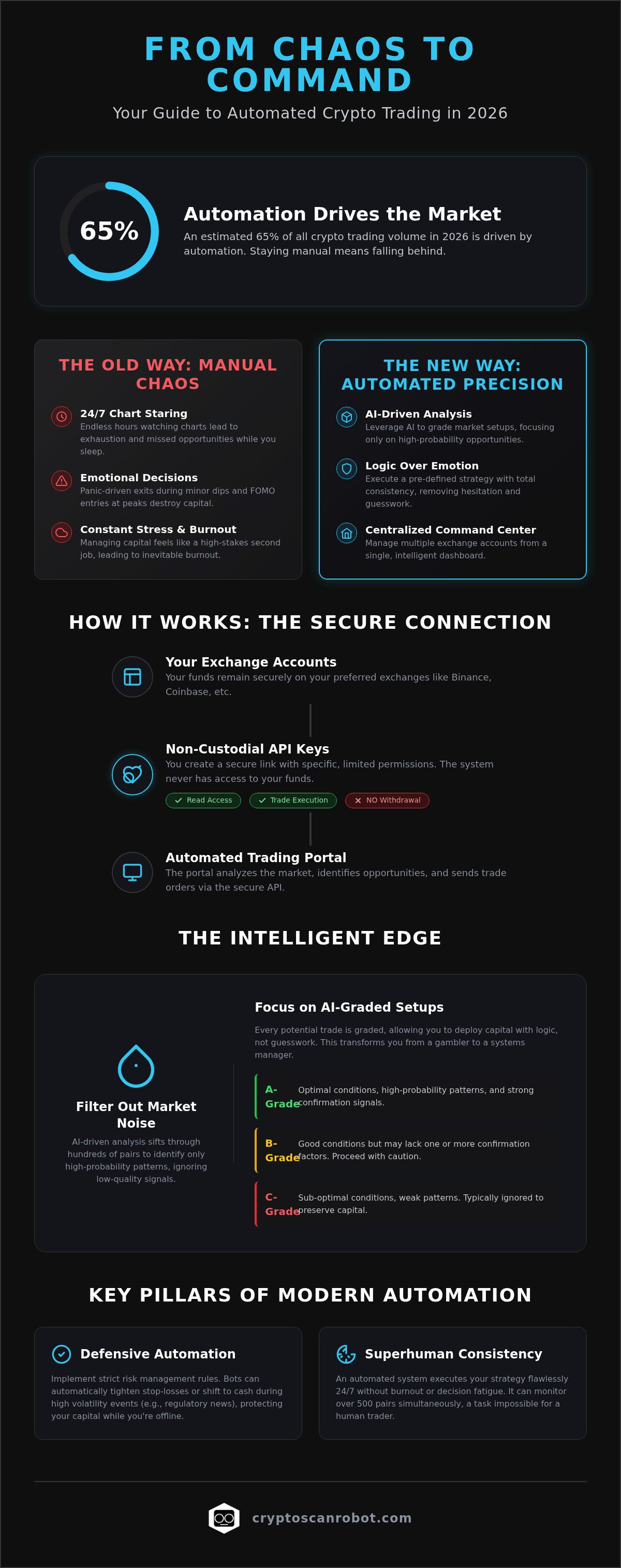
An estimated 65% of all cryptocurrency trading volume in 2026 is now driven by automation. Yet, most traders are still stuck in a cycle of manual entries and emotional exhaustion. You've likely spent nights staring at charts, only to make a panic-driven exit during a minor dip or miss a massive move because you were actually sleeping. It's a chaotic way to manage capital. Fumbling with multiple exchange APIs while your heart rate spikes isn't a strategy; it's a recipe for burnout. You want a way to trade that doesn't feel like a second job or a source of constant stress.
This guide helps you reclaim your time and your sanity. You'll learn how to transition from those messy manual trades to a precision-based automated crypto trading workflow. We'll show you how to prioritize high-probability setups using logical filters instead of gut feelings. We're covering everything from centralized account control to executing a proven strategy with total consistency. It's time to stop reacting to the market and start commanding it from an intelligent dashboard that never sleeps and never panics. Let's move from chaos to cold, hard logic.
Key Takeaways
- Upgrade your approach by leveraging AI-driven market analysis to navigate the 2026 automated crypto trading landscape with high-tech precision.
- Secure your assets using non-custodial API keys that allow for execution without ever granting withdrawal permissions to your trading tools.
- Learn to filter out market noise by focusing on AI-graded setups that prioritize logic and high-probability patterns over emotional guesswork.
- Implement defensive automation by identifying specific market regimes and enforcing strict risk management rules for every active bot.
- Build a centralized command center to manage multiple exchange accounts and execute your strategy with superhuman consistency.
What is Automated Crypto Trading? Decoding the 2026 Landscape
Automated crypto trading is a surgical approach to market execution that replaces human hesitation with binary precision. At its core, it's the use of specialized software to execute entries and exits based on pre-defined logic and real-time market data. In 2026, this technology has evolved far beyond the rigid scripts of the past. Modern systems now incorporate AI-driven market analysis to interpret volatility rather than just reacting to it. Think of it as a sanity filter. It's designed to remove the adrenaline-fueled mistakes that happen when a human tries to outrun a high-frequency algorithm. With an estimated 65% of all crypto volume in 2026 involving some form of automation, staying manual is like bringing a knife to a drone fight.
The Shift from Manual to Algorithmic Logic
The human brain is biologically unsuited for the 24/7 crypto environment. Evolution didn't prepare us for 3:00 AM liquidations or the psychological pressure of a flash crash. This is where Algorithmic trading logic takes over. By using a centralized Trading Portal, you transform your workspace into a command center. You're no longer staring at a single chart and guessing the next move. Instead, you're looking at AI Market Intel Reports that grade setups from A to C. You move from being a gambler to being a manager of intelligent systems. This shift ensures that every trade is backed by a logical reason. It's about grading the setup before the bot ever fires a single order.
Key Benefits: Efficiency, Speed, and Sanity
The primary advantage is simple: robots don't get tired. An automated crypto trading system monitors over 500 pairs simultaneously without experiencing burnout or decision fatigue. It provides an execution speed that manual traders simply cannot match. While you're still clicking "Confirm," the bot has already filled the order at the optimal price point. Beyond speed, automation provides a "Defensive Posture." When the market enters a chaotic regime, such as the volatility surrounding the full enforcement of the EU's MiCA regulation on July 1, 2026, your bot can automatically shift to cash or tighten stop-losses. This protects your capital while you're away from the screen. It's about maintaining control in an environment designed to make you lose it. You get the clarity of a professional desk without the 80-hour work week.
Ultimately, automation allows you to scale your strategy without scaling your stress. It turns a chaotic market into a series of data points to be processed and acted upon with cold, calculated efficiency.
How Automated Trading Bots Interact with Your Portfolio
To understand how automated crypto trading works in practice, you have to look at the relationship between your chosen trading portal and your exchange account. Think of the portal as the mission commander and the API as the secure communications channel. API stands for Application Programming Interface. It's the digital handshake that allows two different software systems to talk to each other. In this setup, the portal is the brain that identifies opportunities, while the API acts as the hands that execute the orders on major global exchanges. This structure ensures your strategy is executed without you ever needing to log into an exchange manually.
Understanding the API Connection
Generating API keys is a straightforward process, but it requires a disciplined approach to security. When you create a key on an exchange, you're presented with a set of permissions. For a non-custodial setup, you should only ever enable 'Read' and 'Trade' permissions. Never enable 'Withdrawal' permissions. This ensures that even if your API key were compromised, your funds could not be moved off the exchange. Using a web-based portal is generally safer than running local software on your own computer. It eliminates the risk of your PC crashing or losing internet connectivity during a critical market move. Modern systems often incorporate a deep learning model for trading to process these API streams faster than any human could, ensuring your execution remains sharp even during peak volatility.
The Dashboard: Your Eye in the Sky
Managing multiple exchange accounts is usually a logistical nightmare. You're constantly switching tabs and trying to calculate your total exposure across different assets. A centralized dashboard solves this by pulling data from every connected API into a single, cohesive view. It's your situational awareness hub. You can see open positions across BTC, ETH, and hundreds of altcoins without leaving the page. However, looking at Profit and Loss (PnL) alone is only half the story. A high-quality dashboard tracks your Return on Investment (ROI) relative to market benchmarks, giving you a clear-headed look at whether your strategy is actually outperforming the baseline. This level of clarity is exactly what you need to maintain your sanity while the market does its thing. If you're ready to stop tab-switching and start commanding, you can connect your accounts to the portal and see the difference a centralized view makes.
By centralizing your metrics, you gain a strategic advantage. You aren't just reacting to price changes on one exchange; you're overseeing an entire ecosystem of automated execution. This allows you to manage open positions with a level of calm that manual traders can't replicate. It turns your portfolio into a well-oiled machine that operates with total transparency. It's a professional setup for anyone serious about automated crypto trading in a high-stakes environment.
Scanning vs. Strategy: Why Intelligence Beats Brute Force
Most traders confuse activity with progress. They think the goal of automated crypto trading is to be in the market at all times. It's the opposite. The goal is to be in the market only when the odds are heavily in your favor. This requires a clear distinction between scanning and strategy. A scanner is your radar; it identifies potential targets. The strategy is your ruleset; it decides which targets are worth the risk. Without a strategy, a scanner just helps you lose money faster. With one, it becomes an elite filtering tool that protects your capital from low-quality setups.
The Power of the Market Scanner Bot
A Market Setup Scanner is a high-speed filter for your portfolio. It processes data from 500+ trading pairs in seconds. While a human trader is still drawing trendlines on a single chart, the scanner has already identified ten high-probability setups across different exchanges. This isn't just about finding any price move. It's about detecting specific volatility patterns that match your risk tolerance before they hit the mainstream news cycle. You can customize scanner alerts to look for the exact technical signatures you trust, ensuring you only see the data that actually matters to your bottom line.
AI Market Intel Reports and Setup Grades
Once the scanner identifies a potential move, AI Market Intel Reports take over to grade the opportunity. Not all patterns are created equal. A Grade A setup typically requires perfect alignment between volume, RSI, and trend direction. If one of these indicators is lagging, the setup might drop to a Grade C. This automated grading system serves as a critical defense mechanism. It filters out the market noise that leads to false breakouts and trapped entries. Scheduling these intel reports allows you to stay ahead of market shifts without needing to be glued to a terminal.
By relying on these grades, you effectively prevent over-trading in choppy or sideways markets. If the intel reports aren't showing anything above a Grade C, your bots simply don't fire. This level of discipline is hard for humans but effortless for software. Even the U.S. Commodity Futures Trading Commission has recognized the growing impact of these technologies, recently issuing a CFTC Request for Comment on AI in Trading to better understand how these systems manage risk. Staying disciplined with automated crypto trading means knowing when to stay out of the market. Using AI to grade your setups ensures you're following a logical path rather than an emotional one.
Step-by-Step: Setting Up Your First Automated Workflow
Setting up an automated system shouldn't feel like a shot in the dark. Most generic guides tell you to link an account and hope for the best. That's a great way to lose your shirt. A professional workflow requires a logical sequence that moves from raw data to validated execution. By treating your setup as a command center, you ensure that every trade has a clear reason for existing. Here is how you build a precision-based automated crypto trading workflow from the ground up.
- Step 1: Secure Connection. Connect your exchange via a secure, trade-only API key. This is your non-custodial link that keeps your funds in your control while giving the portal permission to execute.
- Step 2: Scanner Configuration. Program the scanner to hunt for your preferred technical indicators across 500+ pairs. This is the "eyes" of your operation.
- Step 3: AI Validation. Review the AI Setup Grades. This serves as your sanity filter, ensuring you only act on high-probability 'Grade A' setups.
- Step 4: Bot Deployment. Deploy the bot to execute based on the validated intel. The bot handles the entry with a speed no human can match.
- Step 5: Dashboard Monitoring. Track everything through a centralized dashboard. You get a high-level view of ROI and open positions across all exchange accounts.
Configuring Your Scanner Parameters
Your scanner is only as good as the instructions you give it. You need to align your parameters with your specific trading style. For fast-paced moves, configure the scanner for 5m or 15m timeframes. For more stable trends, stick to 1h or 1d views. You can choose from standard indicators like Bollinger Bands and MACD or rely on custom proprietary grades. If you're testing a new theory, run the scanner in 'Alert-only' mode first. This lets you see the logic in action without risking a single Satoshi until you're confident in the results.
Executing and Monitoring the Trade
Execution is where the strategy meets the order book. Your bot should automatically set Take-Profit and Stop-Loss orders the moment a trade is opened. To maximize returns on a runaway trend, utilize Trailing Stops. These allow the bot to follow the price upward, locking in profits while giving the asset room to breathe. Even with a bot running, you remain the commander. If market regimes shift unexpectedly, use the dashboard to manually override a position or pause the bot entirely. It's about having total control over the machine. Ready to take the lead? You can start building your automated trading workflow and see how logic beats emotion every time.
Best Practices for 2026: Defensive Automation and Market Regimes
Success in automated crypto trading isn't just about finding the right entry. It's about surviving the wrong environment. By 2026, the market has become highly efficient, which means your bots need more than just technical indicators; they need a defensive posture. A logical command center knows that sitting in cash is a strategic move, not a missed opportunity. As the U.S. Digital Asset Market Clarity Act continues to evolve on the Senate floor, your automation must be flexible enough to handle sudden regulatory shifts. High-frequency execution also means being mindful of costs, such as the SEC Section 31 fee of $20.60 per million dollars of transactions. Precision requires looking at the total cost of every trade, not just the potential profit.
- Risk Allocation. Never allocate more than 2% to 5% of your total capital to a single bot instance. This prevents a single "Black Swan" event from compromising your entire portfolio.
- The Weekly Sanity Check. Audit your bot's performance every seven days. Compare the AI setup grades against actual outcomes to see if your scanner logic needs a tune-up.
- Regime Awareness. Use AI Market Intel reports to determine if the market is trending or ranging. A bot designed for a sideways market will fail miserably during a vertical rally.
- Continuous Logic Updates. The market is an active participant that learns from your behavior. Update your scanner parameters monthly to stay ahead of competing algorithms.
Trading the Market Phase, Not Just the Pair
You need to identify whether the market is in a "Risk-On" or "Risk-Off" regime. This often comes down to Bitcoin's dominance and overall volatility. When BTC dominance spikes, altcoin bots often struggle as liquidity leaves smaller pairs. Adjusting your bot's aggression based on these broader phases is what separates professional managers from amateur bot-setters. In many cases, "No Trade" is the most profitable automated decision your system can make. It preserves your capital for high-probability Grade A setups rather than wasting it on low-conviction noise during choppy periods.
Auditing Your Automated Intelligence
Reviewing your closed positions is the only way to find out if your setup grades are accurate. If your Grade A setups are hitting stop-losses more often than your Grade B setups, your logic is flawed. You must prune underperforming pairs from your scanner to keep your execution sharp. Performing a periodic human-in-the-loop strategy review ensures your automated logic hasn't drifted from your original risk parameters during high-volatility events. This is how you maintain a sanity-first approach to automated crypto trading. You are the commander of the machine; the machine is simply the tireless soldier executing your vision with superhuman consistency.
Mastering the Machine: Your Logic-First Future
The shift from chaotic manual entries to algorithmic precision is the ultimate competitive advantage. You've seen how a surgical approach to market execution replaces adrenaline with binary logic. By implementing a centralized command center, you move from guessing to grading every setup. It's about letting the software handle the 24/7 grind while you focus on high-level strategy. This transition to automated crypto trading isn't just about speed; it's about reclaiming your sanity in a market designed to drain it.
You don't have to face the volatility alone. You can take control of your portfolio with the CryptoScanRobot Trading Portal. Leverage AI-generated trade grades, a real-time scanner for 500+ pairs, and a centralized command center for all your exchanges to keep your edge sharp. It's time to trade with the clarity and efficiency of a professional desk. The market never sleeps, but with the right intelligence on your side, you finally can.
Frequently Asked Questions
Is automated crypto trading profitable for beginners?
Automated crypto trading can be profitable for beginners because it eliminates the emotional triggers that usually lead to blown accounts. Instead of panic-selling during a dip, you follow a pre-defined strategy backed by data. Success depends on using high-quality intel and maintaining a defensive posture. It's about following a logical path rather than trying to outguess the market with zero experience.
How much money do I need to start with an automated trading bot?
You can technically start with as little as your exchange's minimum trade size, which is often around $10. However, to manage risk effectively and diversify across multiple pairs, starting with a few hundred dollars is more practical. This allows you to run several bot instances without over-allocating your capital to a single setup. It's better to start small and scale as your strategy proves its consistency.
Can a crypto trading bot steal my money from the exchange?
A bot cannot steal your money if you configure your API keys correctly. By disabling "Withdrawal" permissions on your exchange account, the bot is restricted to only reading market data and executing trades. Your funds stay in your exchange account at all times. This non-custodial setup ensures that you remain the only person with the authority to move your capital to an external wallet.
What is the difference between a crypto scanner and a crypto bot?
A crypto scanner acts as the "eyes" of your operation by filtering hundreds of pairs for specific patterns. A bot acts as the "hands" that execute the orders once those patterns are found. You use the scanner to identify high-probability opportunities and the bot to fire the trades based on your strategy. They work together to form a complete, intelligent command center for your portfolio.
Do I need to leave my computer on for the bot to work?
You don't need to leave your hardware running if you use a web-based trading portal. These systems operate on secure, cloud-based servers that monitor the market 24/7. Your automated crypto trading workflow continues to function even if your laptop is closed or your internet connection drops. This ensures you never miss a Grade A setup because of a local technical failure.
What happens to my bot if the market crashes suddenly?
If the market crashes, a well-configured bot executes the defensive logic you've already programmed. It will hit your stop-losses to preserve capital or stay in cash if the AI intel reports signal a high-risk regime. Unlike a human trader who might freeze in fear, the bot reacts instantly to protect your portfolio. It follows the exit plan with total, cold-blooded efficiency.
How do AI setup grades actually work?
AI setup grades analyze multiple data points like volume, RSI, and trend alignment to determine the quality of a potential trade. The system compares real-time data against historical high-probability patterns to assign a grade from A to C. This serves as a sanity filter. It tells you exactly which setups have the highest mathematical chance of success before you commit any capital to the trade.
Can I use automated trading on mobile devices?
You can manage your automated crypto trading from any mobile device with a web browser. While there isn't a native mobile application, the web portal is fully responsive and designed for mobile use. This allows you to monitor your centralized dashboard, check AI intel reports, and adjust your bot parameters from anywhere in the world. You maintain total command of your trades on the move.
